
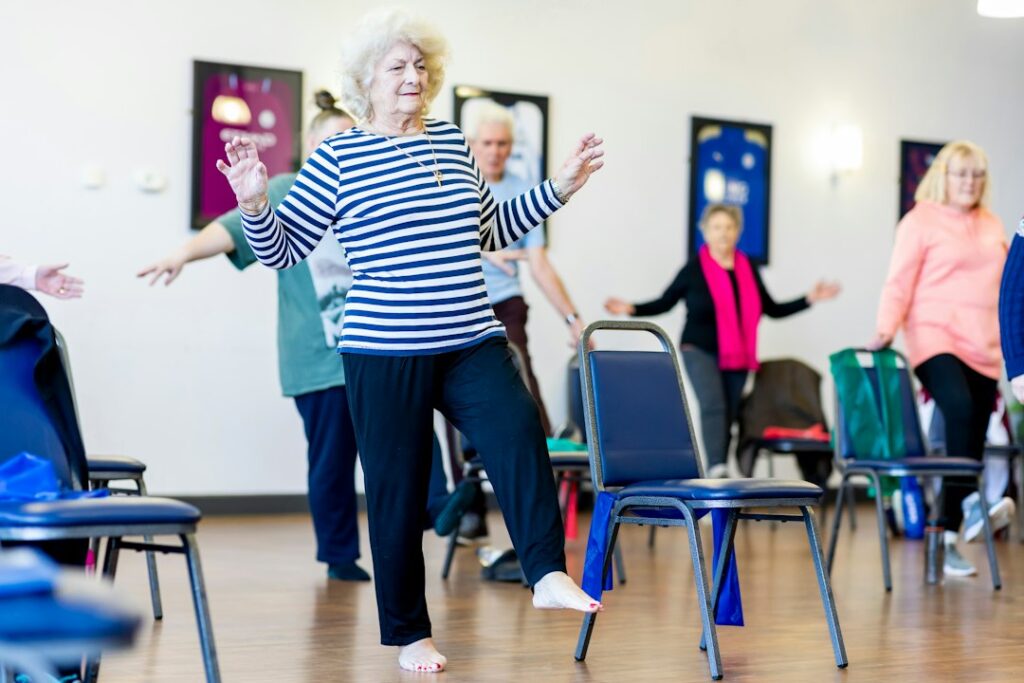
What should a fitness program for assisted living residents include?
A well-designed fitness program for assisted living should support everyday movement, not athletic performance. The most useful programs combine gentle aerobic activity, strength exercises, balance practice, flexibility work, and opportunities for social connection.
Residents may have very different abilities. One person may walk independently, while another uses a cane, walker, or wheelchair. A safe program offers seated, standing, and supported versions of activities so residents can participate at an appropriate level.
Common activities include:
- Seated stretching and range-of-motion exercises
- Walking groups in hallways or outdoor areas
- Chair exercises using light resistance bands
- Sit-to-stand practice from a stable chair
- Gentle tai chi or balance-focused movement
- Light dancing or rhythmic movement
- Supervised use of stationary exercise equipment
- Breathing and relaxation exercises
The goal is consistent movement that helps residents remain as independent as possible in daily routines such as standing from a chair, reaching for clothing, walking to meals, or transferring safely.
Why is exercise important for older adults in assisted living?
Regular physical activity can help maintain strength, balance, flexibility, endurance, and confidence. These abilities affect routine tasks and may help residents continue doing more for themselves.
Strength exercises are especially useful for the legs, hips, back, shoulders, and arms. Even modest strengthening may make activities such as rising from bed, carrying a light object, or using a walker less tiring.
Balance practice may help residents respond more safely to changes in position or uneven footing. It does not eliminate the possibility of falling, but it can be part of a broader fall-prevention approach that also includes proper footwear, clear walkways, adequate lighting, and correctly adjusted mobility equipment.
Movement may also support sleep, mood, appetite, and social engagement. Group classes can give residents a predictable reason to leave their rooms, interact with neighbors, and build confidence through familiar routines.
How much activity do seniors need?
For adults age 65 and older, national guidance generally calls for a combination of aerobic activity, muscle strengthening, and balance exercises during the week. A commonly cited target is 150 minutes of moderate aerobic activity weekly, along with muscle-strengthening activities on at least two days and regular balance practice.
That target is not an all-or-nothing requirement. Residents with chronic conditions, limited mobility, fatigue, pain, or significant weakness should be active according to their abilities. Short sessions may be more realistic than a single long workout.
For example, a resident might:
- Walk for five to ten minutes several times during the day
- Complete seated exercises for ten minutes in the morning
- Practice supported standing for a few repetitions
- Join a gentle group class twice each week
- Perform stretches after meals or during television breaks
Several short periods of activity can be more manageable than one demanding session. Progress may mean moving more comfortably, recovering faster, or needing less assistance rather than exercising for a longer time.
Which exercises are safest for residents with limited mobility?
Chair-based and supported exercises can be appropriate for people who cannot stand for long periods. Seated leg extensions, ankle movements, arm raises, gentle trunk rotation, and resistance-band exercises can help maintain movement and muscle use.
Residents who can stand safely may benefit from activities such as:
- Repeatedly rising from a chair with support nearby
- Marching in place while holding a stable surface
- Shifting weight from side to side
- Taking slow steps along a clear hallway
- Practicing turning and stopping under supervision

Balance exercises should not be attempted near furniture that can slide or roll. A walker, countertop, parallel bar, or other stable support may be appropriate, depending on the resident’s care plan. A rolling chair is not a safe substitute for a stable support.
Exercises should be adapted for conditions such as arthritis, osteoporosis, stroke-related weakness, Parkinson’s disease, heart or lung disease, diabetes, or recent surgery. A resident’s clinical care team should help determine which movements are suitable when a health condition affects safety.
What does a typical assisted living fitness class look like?
A typical class may last 20 to 45 minutes and begin with a gradual warm-up. The instructor may then guide residents through seated or standing movements, followed by strength, balance, and stretching activities.
A practical session might include:
1. Gentle shoulder, ankle, and neck movements
2. Slow marching while seated or standing
3. Arm exercises with light resistance
4. Sit-to-stand practice or supported leg exercises
5. Simple balance activities
6. Cool-down breathing and stretching
The pace should allow residents to understand instructions and change positions safely. There should be time for water, rest, and questions. A class that is too fast, crowded, or difficult to hear may not be appropriate, even if the exercises themselves appear gentle.
Music, familiar routines, and simple demonstrations can make participation easier. However, enjoyment should not replace attention to safety or individual limitations.
How can residents exercise safely during Sewickley winters?
Cold weather, snow, ice, and early darkness can make outdoor walking less practical during winter. Indoor walking routes, hallways, activity rooms, and seated exercise sessions can help residents maintain routines when sidewalks or driveways are slippery.
Residents should use footwear that fits securely and provides adequate traction indoors and outdoors. Coats, scarves, and other winter clothing should not restrict movement or create tripping hazards. Wet floors near entrances also require caution during periods of snow and rain.
On warmer days, outdoor movement may be comfortable, but heat, humidity, and direct sun can increase fatigue. Programs should include shaded rest areas, water breaks, and shorter sessions when conditions are uncomfortable.
What warning signs mean an exercise should stop?
Exercise should stop if a resident experiences chest pressure, severe shortness of breath, faintness, sudden confusion, unusual weakness, new loss of coordination, or significant pain. New or worsening symptoms should be reported according to the resident’s care plan.
Mild muscle effort, temporary fatigue, and gentle stretching sensations may be expected. Sharp pain, joint instability, dizziness, or symptoms that continue after resting deserve attention.
Residents should also tell care staff about recent falls, changes in walking ability, medication changes, swelling, or unusual tiredness. These details can affect whether an activity should be modified or postponed.
How can families tell whether a program is truly useful?
A useful program is not measured only by attendance or the number of exercises completed. Signs of value may include safer transfers, improved confidence, more comfortable walking, better participation in daily activities, or greater willingness to move independently.
Families can ask whether the program offers different ability levels, records participation when appropriate, allows rest periods, and coordinates with individual care plans. It is also reasonable to ask how the program accommodates residents who have memory loss, hearing difficulty, vision changes, or communication challenges.
The most effective routine is usually one that residents can understand, enjoy, and repeat consistently. In assisted living, fitness is less about reaching a demanding workout target and more about preserving movement, safety, confidence, and participation in daily life.
